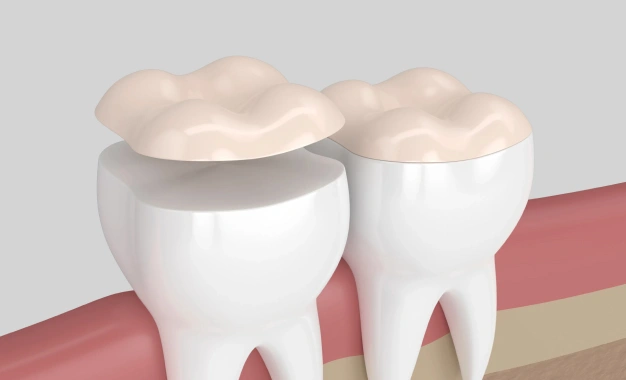
When a tooth has extensive damage—especially on the biting surface—fillings alone may not be enough. In these cases, inlays and onlays offer a durable, long-lasting solution that restores strength and function while preserving your natural tooth structure.
What Are Inlays and Onlays?
Inlays and Onlays are custom-made restorations crafted from porcelain, composite resin, or sometimes gold.
Inlays fit within the cusps (the pointed parts) of the tooth.
Onlays cover one or more cusps and are used when more coverage is needed.
These restorations are designed to blend seamlessly with your natural teeth and provide added durability—making them a great choice for teeth with moderate to severe decay or damage.
How the Procedure Works
Two visits are typically required to complete an inlay or onlay:
First Visit:
We begin by removing any decay or old filling material and preparing the tooth. An impression is taken and sent to a dental lab, where your custom inlay or onlay is created. A temporary restoration is placed to protect your tooth until your next visit.
Second Visit:
At your follow-up appointment, we remove the temporary and check the fit of your new restoration. Once everything looks and feels right, we bond the inlay or onlay to your tooth using a strong dental adhesive and polish it for a smooth, natural finish.
Why Choose Inlays or Onlays?
Compared to traditional fillings, inlays and onlays offer several benefits:
Stronger teeth: They can strengthen a tooth by up to 75%.
Long-lasting: With proper care, they can last 10–30 years.
Natural appearance: Porcelain and composite options blend beautifully with your natural tooth color.
Conservative treatment: They preserve more of your healthy tooth compared to crowns.
If a tooth is too damaged for a filling but not quite ready for a crown, inlays and onlays are an excellent in-between solution.